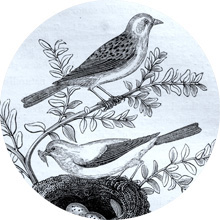

My history of the Belgian canary in Belgium will depart from convention and look at it in reverse order, working my way back from the end of the nineteenth century to its origins in the eighteenth. Why? Because I think it gets more interesting.
My starting point is the illustration at the head of this article. It was drawn by Louis Vander Snickt, described as ‘de vader van de kleinliefhebberij van België ’ (the father of the small livestock fancy in Belgium) (1). He bred canaries amongst the many birds and animals he kept.
Painted in 1888, it is the earliest illustration of Belgian canaries actually produced in Belgium that I, or Gust Truyens, have come across. Almost all earlier prints are of British origin. Vander Snickt was a gifted amateur artist. He drew the birds as he saw them, in natural poses, unlike British illustrators who almost always depicted the ‘ideal’ show bird.
No contemporary show standard published by the Belgian canary societies has survived as far as I am aware, but we know exactly what the Belgian breeders regarded as the ideal postuurvogel (posture bird) thanks to the correspondence between Blakston and his Special Foreign Correspondent’ (SFC). The two men were evidently in regular contact; Blakston sending proofs of the text and illustrations of his magnum opus to the SFC for comment (2). Blakston even supplemented the third chapter on the Belgian canary at the last minute to incorporate some of the SFC’s corrections (3).
The SFC was critical of the common misconceptions amongst British breeders, such as their emphasis on colour and dislike of variegated birds (unless they were even-marked) (4). However his greatest criticism concerned the most important characteristic of the Belgian canary: its posture. In his first chapter on the Belgian canary, Blakston had described and illustrated birds with their shoulders raised and their necks stretched downwards. (5)

The SFC was not impressed He had sent Blakston a bronze model, accredited by one of the Flemish societies, to be engraved and reproduced in The Illustrated Book of Canaries and Cage Birds (6). He must also have seen an advance copy of both the engraving and the illustrations because he wrote “I must congratulate you on the excellence of the rendering of the bronze model. I cannot, however, say so much regarding the engraving on page 190 . . .“

He continued:
“I will give you what I have gathered from our best judges … the time of forming the decision of comparison is not at the moment of acme of stretch when the bird is standing with its head en bas [at its low point], but immediately afterwards, when it has elevated its head and assumed an easier attitude … It is neither shoulders nor back but what is, in Flemish, expressed in a word ‘afgewerk’, the ‘working off’. You will notice at once what I mean if you compare the two engravings. The ‘afgewerk’ of the [bronze] model is excellent; that of the other figure, at any rate in the position represented, rather inferior …”
It is a categorical statement; the bronze model represented the Belgian canary as Belgian breeders intended it to be. The bird only adopted its perfect position as it recovered from being at full downward stretch, creating a triangular profile that is fundamental to the breed:

The SFC’s description also confirms that the British vision of the Belgian canary, with its head pointing sharply downwards, was wrong. Both positions are inherent in the breed. Donald Skinner-Reid was kind enough to send me these photographs of one of his 2021 youngsters before the first moult. Here we see it standing in the position admired by the Belgian breeders of the nineteenth century:

And here in the position which the British fanciers preferred:

The Belgian was a large canary, with a claimed length varying from 6½” to 8” (16,5 to 20,5 cm) although, as Wallace noted, ‘few will be found to exceed 7” [18 cm]’ (7). This has led to speculation that the postuurvogel was descended from a variety named the Grote Gentse vogel (great Ghent bird) in its homeland, ’Old Dutch’ in England, and Canari Hollandais in France. It is one of those legends that riddle canary history; it sounds plausible, but doubts arise as soon as you look at the evidence. Let me give you an example.

Here is an illustration of a pair of Belgian canaries from the Club Italiano Canarino Lancashire website. It is entitled ‘Canarini Gantesi’ (Ghent canary) which seems to corroborate the legend, but it is fake. It was copied from an illustration in Rev. Francis Smith’s ‘The Canary’ (1868) entitled ‘The Belgian Canary’ and given a new title. Here is the original:

I have also come across claims that the Grote Gentse vogel was developed from the Waterslager song canary bred by monks in Flemish monasteries in the first half of the 16th century. It is a romantic, but unlikely, notion.
Most of the canaries available in the United Provides at that time would have been wild-caught birds. The earliest Dutch references to canaries that Gust has discovered are advertisements for canaries imported “from the Azores” in 1667-68 (8). However, the market was soon dominated by German canaries which arrived in Holland (and England) circa 1670, but these were mostly common song birds (9). By the dawn of the 18th century, variegation and some colour variants were noted in Hervieux’s famous list of 28 varieties (10), but there is no mention of size, let alone ‘type’. Now it is true that the Waterslager is a canary cultivated for its song and it is significantly larger than other song varieties, but according to the Belgische Federatie van Liefhebbers (Belgian Federation of Canary Enthusiasts), the development of the breed only started around the middle of the 19th century (11). It follows that the Waterslager cannot be the ancestor of the Grote Gentse vogel. Indeed, the reverse is more likely to be true.
The biggest difficulty for historians is that the Grote Gentse vogel / Old Dutch canary was never described, let alone illustrated, in contemporary Belgian or Dutch publications. Yet again we have to rely on English authors. Both Wallace (1875) and Blakston (1878) commented on the large size and rough ‘woolly’ feathering of the Old Dutch canary, but as usual disagreed on everything else, Wallace calling the breed ‘handsome’ while Blakston considered it ‘ungainly’. Significantly, neither mentioned a hunchback profile.

A different insight was given by Bernard P. Brent in his series on canaries published in ‘The Cottage Gardner’ in 1860 (12). In his introduction he pointed out that, as far as British breeders were concerned, the term ‘Belgian canary’ was a loose term that covered several varieties:
“The Belgian Canaries are admired for their great length and handsome form. They are pre-eminently birds of position, and are divided into three distinct breeds, or subvarieties – namely, the Erect Belgium, the Rough Belgian, and the Hooped or Bowed birds. They are supposed originally to have been bred in Austria, and thence introduced into the Netherlands. We have received some from Holland, but our principal supply is from Belgium: hence their common name of Belgian Canaries.”
He went on to describe each of these varieties. The Erect Belgium corresponds to the Grote Gentse vogel (which Blakston and Wallace called the ‘old Dutch’); the Rough Belgian to the frilled canary (probably the ancestor of the North Dutch canary); and the Hooped or Bowed Belgian which was similar to the classic Belgian canary, but with a curved back. I will return to these varieties later in this series.

Another insight into the early Belgian/Dutch canaries is given in a small booklet first published in 1852 by Jules Jannin, a French oiseleur (13). He tells us “These canaries, imported into France about fifty years ago, come to us from Holland and Belgium, where the first examples were created”. That would take us to the dawn of the 19th century. He described them thus:
“The Dutch canary, to meet all the conditions of height, must: 1) be high on the legs; 2) have the head completely clear of the shoulders; 3) present, throughout its length, a slightly arched shape; 4) have the feathers of the back silky falling on each side on the wings, long enough to support them, and those of the tail implanted straight, without forming a fan at the end as in ordinary canaries.”
The description accords with Brent’s Hooped or Bowed Belgian: long legs and neck, and a slightly arched back. I was puzzled by the long silky feathering, but when I checked with Donald Skinner-Reid whether he had seen this on the back of a Belgian canary, he confirmed “one sees the long feathers, almost like a mantle on a frilled bird. Some Scots have it too”. Could it be a common ancestor of both varieties? If so, can we trace its origins?
Brent tells us that the Belgian canaries were descended from birds imported from Austria. We don’t know the source of his information, but it seems highly plausible. Thanks to Jaap Plokker’s research, we know that from the late 17th century to the early 19th century, the canary trade in Europe was dominated by the itinerant bird sellers from the Tyrol, Bavaria and Switzerland (14). It was a remarkable enterprise; the bird sellers travelled through Germany, carrying the birds in tiny cages on their backs, to sell as far afield as the low countries, France, Britain, Poland and Russia.

The trade was described by Daines Barrington (15) in 1773 thus:
“Most of those Canary-birds, which are imported from the Tyrol, have been educated by parents, the progenitor of which was introduced by a nightingale; our English Canary-birds have commonly more of the titlark note.
The trafficking of these birds makes a small article of commerce, as four Tyrolese generally bring over to England sixteen hundred every year and though they carry them on their backs one thousand miles, as well as pay £20 duty for such a number, yet upon the whole it answers to sell these birds at 5s [5 shillings or 25p] a piece.
The chief place for breeding Canary-birds is Innsbruck and its environs, from whence they are sent to Constantinople, as well as every part of Europe.”
While their principal trade was in song canaries, they also exported crested canaries to Holland from 1734 (16) and the first colour variants (viz. white and cinnamon) even earlier than that. Could the German breeders have developed the earliest posture canaries too?
It seems they may have.
Regular readers may remember my articles on the Nuremberg Lizard and the pivotal role played by Christoph Jacob Trew in sponsoring talented artists such as Johann Daniel Meyer and Georg Dionysius Ehret. Another of his protégés was Barbara Regina Dietzsch, who also lived in Nuremberg, and is best known for her exquisite flower paintings (17). Fortunately for us, she also painted birds, including this one of a yellow canary published in the 1770s:

It is a candid portrait of a bird preening rather than the more common view of a canary posing like a show bird. Dietzsch’s precise technique is evident in the fine feather texture and the exposed white underflue. We can be confident it was drawn from life and that it was selected because it was special in some way; probably a prized possession of one of her patrons and intended to impress the sort of people who could afford to buy a copy of her book. (18)
It displays two interesting features: the first is that it has an elongated shape; the second is its long neck. I don’t want to overstate the case here; the neck would naturally be stretched while preening, but Dietzsch’s rendering does seem to accentuate its length. It is not a Belgian canary, but I do think it demonstrates the sort of features that were being cultivated in eighteenth century Germany.
As so often, the German breeders were the source of several attractive variations in the canary throughout the eighteenth century, but it was the fanciers in other countries that refined them and brought them to perfection.
___________
Acknowledgements & clarifications:
- My thanks to Boudewijn Goddeeris for permitting me to reproduce the painting by Louis Vander Snickt and my thanks to Gust Truyens for bringing him to my attention.
- I have used two types of brackets (parentheses) in the above text. Curved brackets clarify something I, or the original author, have written; square brackets signify my clarification of what someone else has written. There are occasions when both are used in the same quotation.
- Many European regions and towns were given different names and spellings in English (e.g. Nürnberg is known as Nuremberg, Gent as Ghent). As this is an English language blog, I have followed this custom, with apologies to my German and Belgian readers.
Footnotes:
- Boudewijn Goddeeris ‘Louis Vander Snickt (1837-1911), ‘De vader van de kleinliefhebberij van België’ published in Het Vlaams Neerhof, 2011.
- Blakston W. A., Swaysland W., Wiener August F., “The Illustrated Book of Canaries and Cage-Birds”, 55 chromolithograph plates, first series published by London, Cassell, Petter, Galpin & Co, 1877-81 (p.217).
- Blakston acknowledged that it was too late to correct errors in the first two chapters “since the preceding pages are in type”.
- ‘Even marked’ birds displayed symmetrical dark markings around the eyes and on the wings and tail. They were very popular in the Victorian period, but being a form of variegation, did not breed true.
- Blakston’s original description was “ . . . they draw themselves up farther and farther till their legs are perfectly straight and rigid, showing a portion of the thigh . . . In this straining with the shoulders the head is depressed and the neck stretched to its extreme limit, not with any distressing exertion, but with the most consummate ease and grace . . . The moment the bird begins to extend its neck or to ‘reach’, as it is technically termed, and the head is correspondingly depressed, its direction is altered and it begins to point downwards, continuing to do so . . . until the head is bent until the beak points inwards . . . as seen in the Variegated Yellow bird in the coloured illustration, which is by no means an exaggerated representation . . .”
- Blakston writes “A model, cast in bronze, the accredited standard for the year of one of the Flemish societies, of which an illustration is furnished in Fig 55, stands before us, and also exhibits the straight back with the tail in a continuous straight line.”
- R.L. Wallace ‘The Canary Book’ first edition 1875, p.112.
- The Oprechte Haerlemse Courant 1670/09/06,4. The advertisement states “De Liefhebbers werdt bekent gemaeckt, als dat Frans Goossensz. de Vogelaer nu self is t’huys gekomen van de Vlaemse Eylanden, met een goede party Canari Vogels, die hy verkoop by ‘t stuck of by ‘t dosijn . . .” (Fanciers are made aware that Frans Goossensz, the bird merchant, is now at home from the Azores with a good party of canary-birds, which they can buy by the piece or by the dozen . . .”). The wild canary is not indigenous to the Azores, and Gust believes that the birds were probably picked up at Tenerife or Madeira as the ship tacked homewards.
- J.B. Gent (Joseph Blagrave) The Epitome of the Art of Husbandry (second edition 1675). He tells us “Birds brought from the Canaries are not so esteemed as formerly, for the Birds brought out of Germany far exceed them for handsomeness and Songs”. Furthermore, most were the wild type, “Many Country-People cannot distinguish a Canary from one of our common Green-Birds”.
- Hervieux de Chanteloup “Nouveau traité des serins de Canaries” (first edition 1709), p.4&5.
- Thijs H., Belgische Waterslager en Mechelense Zangkanarievogel, first published in 1912 and reprinted by Marcel Tielens in 1970.
- B.P. Brent ‘The Cottage Gardner and Country Gentleman’, a series in 12 parts on canary varieties published from 1 May to 6 November 1860. Brent corresponded with Charles Darwin (mainly on pigeon varieties) during his preparation of ‘The Variation of Animals and Plants under Domestication’ (1868).
- Jules Jannin, L’art d’élever et de multiplier les Serins Canaris et Hollandais, first edition 1852. There were several reprints up to 1958. My copy is dated 1937, but it makes no reference to later breeds such as the Parisian Frill, which one would expect if the content had been updated in successive editions. It implies that the text is unchanged from the original.
- Jaap Plokker, “Ambulante kanariehandelaren te Leiden in de 18e en 19e eeuw” (Itinerant canary traders of Leiden in the 18th and 19th centuries). http://84.105.133.134:8081/NZHU/Artikelen.html#Geschiedenis
- Daines Barrington Experiments and Observations on the Singing of Birds, 1773. Barrington was a lawyer by profession, but also a prominent naturalist and antiquary, and a member of the Royal Society.
- Frans van Wickede Kanari-uitspanningen of nieuwe Verhandeling van de kanari-teelt ,(1750, my copy is the 1762 edition), p.12. He states “ now you find Canary birds with crests, which have been seen here since 1734 . . . it is said they were first cultivated in Nuremberg”. The book is based on Hervieux’s Nouveau traité des serins de Canarie (first edition 1709), with many revisions and additions based on van Wickede’s own knowledge of the bird trade in the Netherlands
- Dietzsch contributed coloured plates for Trew’s Hortus Nitidissimis in three volumes (1768-1786).
- Sammlung meistens Deutscher Vogel (Collection of Mostly German Birds) illustrated by Barbara Regina Dietzsch and engraved by Adam Ludwig Wirsing (1772-1777). Dietzsch’s portrait of the canary was copied by James Bolton for his two volume ornithological work Harmonia Ruralis (1794-1796).

Bolton’s copy of the Dietzsch drawing published in ‘Harmonia Ruralis’.
According to Marcel Legendre the description of the belgian canary is as follows:
Head: Small, slightly oval in shape Neck: Long and slender, capable of extension Shoulders: High, square, massive, well-feathered between the wingtips Back: Long, plump Breast: Prominent, well-developed Wings: Long, compact, held close to the ribs and meeting level at the tips without crossing Tail: Long and compact, narrow and straight Legs: Long and straight, well-feathered Plumage: Smooth, in good condition, no frizz Size: 18 cm measured from the tip of the beak to the tip of the tail, following the line of the head and shoulders Poise: Comfortable stance, with the back and tail line approaching vertical. In fact, the bird should form a right angle from the head to the tip of the tail.
Belgian Canary scoring system: Head: 10 points Neck: 10 points Shoulders: 20 points Wings: 5 points Tail: 5 points Legs: 5 points Stance: 30 points Color: 5 points Size: 5 points Condition: 5 points Total: 100 points.
It’s a pity that we don’t know the date of this standard. Interesting that high shoulders were given so many points. It seems to accord with Fig 2 of Mr Robertson’s illustration of the ‘new’ and ‘old’ Belgian canaries (the last illustration in the article). They spoil the bird in my opinion.
It also says “well filled between the shoulders”
Darwin in the origin of species had noticed that there is a kind of correlation with long legs and elongated heads…
Anyway this variety is only showing such a position when it is “at work”