In 1853 Robert Wallace visited Joseph Greenwell, a bird dealer in the county of Durham, to purchase his first Belgian canaries (1). He found several ‘old practical hands’ already waiting at Greenwell’s house, and a bidding war ensued as soon as he put the birds on display. The type of bird they wanted was “so exceedingly slender that . . . it could be passed through a lady’s gold ring”.
Wallace’s eye, however, was drawn to a “noble yellow hen with immense shoulders, a nice sleek head, good neck, legs etc”. The bird elicited several ‘witticisms’; one old hand likened her to a young camel, another to Richard III (a hunchback). Wallace was not deterred and bought the bird. In fact he liked the bird so much that he asked a friend who did business in Belgium to procure “a pair or two of the best Belgian canaries they could obtain . . . and furthermore, to send the kind that was most highly esteemed in that country”. Four birds eventually arrived and Wallace was delighted to discover that they not only “proved to be the very identical counterparts of my ‘deformed’ hen” but also “were of the best and most highly prized strains and were much dearer than the birds usually sold for exportation”.
His enterprise was so successful that he received “numerous applications for the progeny of my ‘crooked backed’ birds, as they were frequently designated” and “three or four years after this some of our most ardent fanciers ventured across the Channel and selected their own stock . . .” He even gave instructions to his readers on how to import birds for themselves. Wallace didn’t relate this story out of casual interest. He clearly regarded himself as a pioneer, one of the first to import Belgian postuurvogels into Britain, and he wanted the credit for it.
If Wallace really was one of the first, it is surprising that they had taken so long to arrive on British shores. Canaries had probably been imported into Great Britain from Belgium since the early 1830s, but they were probably not what we now regard as the classic Belgian canary. These early birds were never described in detail, as an advertisement by a Mrs. Freestone in 1840 shows. She claimed to have “received some BELGIAN CANARIES unrivalled for size and shape” for her shop in St. Martin’s Lane, London (2). Unfortunately she did not state what that size and shape was.

This is a typical example of the problem facing modern researchers: the term ‘Belgian canary’ could have applied to almost any canary that came from Belgium, Holland, or even northern France. As we saw in Part 2 of this series, Brent described three sub-varieties, and Wallace added a fourth with his reference to ‘exceedingly slender’ canaries (3). Things were complicated further by the fact that most Belgian canaries were imported by dealers and there was no way for British breeders to verify the origins of the birds they bought.
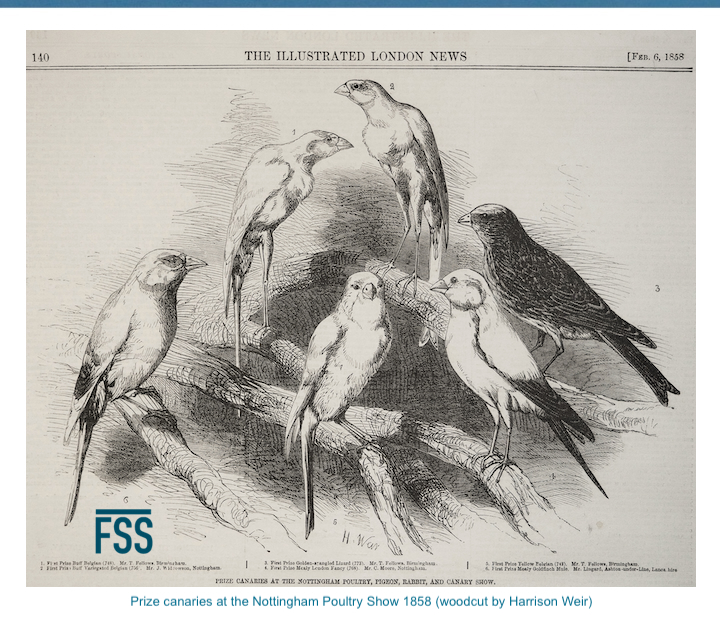
The first illustration of Belgian canaries accompanied a brief report on the second Nottingham Poultry Show published in the Illustrated London News on 6 February 1858. It was signed H. Weir, one of the most prolific illustrators of birds and animals in the 19th century (4). Harrison Weir was renowned for the speed and accuracy of his work, drawing the image on a block of fine-grained boxwood, which was then engraved and used as a printing plate. His illustration of canaries was almost certainly drawn by hand while he was at the show; the birds appear natural, unlike the portraits of ‘ideal’ show birds that we usually see in Victorian bird books (5).

At first glance the two birds described as Belgian canaries do indeed look like Belgians: high shoulders, long in the leg, and an outstretched head. Look more closely, however, and it is apparent that they are not the postuurvogel that Blakston’s SFC had described, but Brent’s ‘Hooped Belgian’ with a gently curved back (q.v. Part 2).

There is no doubt that some British breeders regarded them as the correct type. A long letter published in the Nottinghamshire Guardian on 7 May 1857 from ‘JV’ (John Varley) sought to explain the show points of various breeds of canary (6). Under point 5 of the Standard Properties of Belgian Canaries he states “back – curving convexly and well filled; that is, not hollow”, and under point 8 “tail – curving in continuous circle with the back”. He made no mention of the straight-backed form.
Varley rectified this omission in his book ‘Exhibition Canaries’ published two years later. He provided a description of a variety he named as ‘Brussels or Dutch canaries’ which were straight “from neck to the tip of the tail’, had square shoulders, and a neck that extended forward horizontally”. This, undoubtedly, was the postuurvogel of the Flemish canary societies. Even so, Varley made it clear that he preferred the ‘gracefully curved’ form, which he considered to be the “pure Belgian (old French) Canary”.
The profusion of place names that Varley uses is confusing, so for the remainder of this series I will adopt Brent’s name of Hooped Belgian for the canaries with curved backs. Were they a distinct breed or just faulty postuurvogels, refuse stock that Belgian breeders were happy to offload to British dealers and their gullible customers? One correspondent to The Field magazine was under no doubt:
“Very few high class Belgian birds find their way to England. They breed an inferior bird for the foreign market, which they sell at a low figure, and I think it from these that many of the English birds have been bred.” (7)
The confusion over what constituted the correct shape for the Belgian canary continued into the next decade. When Wallace described the ideal Belgian in The Canary Book in 1875, he made it clear that the “back as well as the tail should be almost perpendicular”, yet the illustration of the winning Belgian at the Crystal Palace show of 1874 shows a bird with gently curved back and tail. Compare it to Weir’s illustration from the Illustrated London News, and the similarity is striking.

Blakston’s account of the Belgian canary in The Illustrated Book of Canaries and Cage-Birds (1877-81) established an archetype of the breed that endured in Britain for the remainder of the century. His famous colour plate shows three Belgian canaries in show position: they stand erect with a straight back, the shoulders forming a peak before the head and neck plummet down towards the perch. It was a dramatic stance, and clearly made a big impact on British fanciers, but it was wrong. It was only when the SFC sent him the bronze model adopted by one of the Belgian societies that Blakston realised the Belgian canary should have a triangular posture (q.v. Part 2). At least he had the good grace to acknowledge his error, and added an extra chapter to his book to explain the correct show position with the neck and head almost horizontal.

Unfortunately for the breed, the SFC’s guidance was ignored; British fanciers preferred their Belgians to stand upright but look downwards; the more extreme the stance, the better. A direct consequence of this action was that the shoulders acquired greater prominence, and high shoulders became a defining feature of British-bred Belgian canaries. By the time that Wallace published the third edition of The Canary Book (1893), featuring yet another shoulders-up-head-down illustration, the classic triangular shaped postuurvogel was becoming a distant memory in Britain (8).
The scale of the export market for Belgian canaries becomes clear in an article that appeared in Canary and Cage Bird Life in 1905. It concerned a Mr. John F. Dewar of Edinburgh who had started as a bird dealer around 1855, and was the proprietor of “probably the best business of its kind in Scotland”. He had kept records of his dealings with Belgium from his first visit in 1882. By the time of his final visit in 1893, he had “imported over 1,000 Belgians during those years, and won the highest awards at all the leading shows for many years”. We can only guess what the total number of Belgians imported into Great Britain must have been. (9)

Mr. Dewar also produced a woodcut regarded as “one of the finest blocks of a Belgian yet seen” circa 1894. It shows a Belgian canary in the shoulders-up, head-down pose beloved by British fanciers. Given the importance of the British market, it seems that the Belgian breeders were producing birds that appealed to British tastes. The inevitably consequence was that the integrity of the breed was being undermined not only in Britain but also in its homeland.

The popularity of the Belgian canary had peaked in Belgium and in Britain well before the turn of the 20th century. You can tell it was in trouble when, in 1911, Claude St. John opened his chapter on Belgian canaries (10) with the words:
“In the Belgian we have truly a deposed King indeed. From the proud position of being universally acknowledged by the title of ‘King of the Fancy’, with a host of admirers who bred and loved it for its own sake . . . we now find it in the hands of a very few of its most ardent old admirers who preserve it from immediate extinction.”
He quoted ‘veteran Belgian enthusiast’ Mr. James Robertson, who made a forlorn plea for the ‘old and true’ Belgian. It is only when you see his accompanying drawing that you realise that what Mr. Robertson referred to as the ‘old type’ in sketch No.1 was actually the exaggerated British style, not the classic postuurvogel. Unfortunately the bird in sketch No.2, which he described as ‘another style’, was no better. It may have held its neck horizontally, but the high shoulders were ungainly and it is no surprise that the breed fell out of favour.

By 1923, the Belgian canary had all but disappeared. C.A.House admitted that:
“One can visit twenty shows in a season and not see one single specimen of the breed, and it is many years since a I saw a class of Belgians at an English show.” (11)
The love affair between the British fanciers and the Belgian canary was over, and it was left to others to pick up the pieces, a subject I will cover in Part 6 of this series.
It is a sobering to weigh up the contribution that Britain made to the history of the Belgian canary. We can thank British authors and illustrators for producing an invaluable archive; without them the history of the breed would be little more than guesswork. In almost every other respect, the impact of the British on the Belgian canary was, in my opinion, detrimental for one fundamental reason. For all their fine words, few British fanciers understood the Belgian canary; they exploited it to suit themselves without worrying about the consequences. We know from recent experience the damage that can be caused when one nationality tries to impose its opinions on the traditional values of the home nation.
Acknowledgements:
- My thanks to Andy Early for the loan of his bound volumes of Canary and Cage Bird Life, from which I’ve taken several illustrations and quotations.
Footnotes:
- Robert Wallace, ’The Canary Book’, first edition 1875, (p.113).
- The Morning Herald, 18 May 1840, London. It was followed by many advertisements for Belgian canaries being imported by dealers in the 1840s and 50s. None of them describe the birds.
- The ‘exceedingly slender’ canaries may well have been the Saksische canaries mentioned in Part 2. They were bred for their song and were the forerunners of the Roller (Harz) canary.
- Weir had joined the ILN in 1843 and there have been suggestions that it was he who produced the illustrations of the London Fancies and Lizard canary in the celebrated edition of 12 December 1846. It’s a nice theory, but as ever in the canary world, the truth is rather different. The illustrations were drawn and engraved by Messrs Archer and Linton respectively.
- Weir lived in the South of England and must have made a special journey to visit the show, no doubt because the first Nottingham Poultry show (aka ‘the first All-England Show’) the previous year must have created a lot of interest.
- This is the same John Varley we met in Part 1.
- ‘The Field’, 21 February 1863. The correspondent wrote under the pseudonym ‘CYNIC’.
- R.L. Wallace, ‘The Canary Book’, third edition (1893). Interestingly Wallace retained the original text and made no comment on the ‘modern’ Belgian canary. It suggests he disapproved.
- ‘One of Scotland’s oldest naturalists: Mr. John F. Dewar’, Canary and Cage Bird Life, 20 October 1905.
- Claude St. John, ’Our Canaries’, published by Cage Birds, London, 1912 (p.227).
- C.A. House, ‘Canaries’ first edition (1923), p.135.
C.A. House Canaries 2nd edition p 132 upto p 141 give a good description of a Belgian canary as well as the standard compiled by the United Kingdom Belgian Canary Association (60 pts for all physical details and 40 pts for position)
I have the first edition (1923). The standard states “head-depressed” and both illustrations show the Belgian in the shoulders-up-head-down position preferred by British breeders. Legendre must have been referring to a different standard.
On p 133 & 139
are 2 drawings of the belgian canary head down and massive shoulders (illustrations by H. Norman)
House said that the normal standard 100 pts was of no use to the judges as during the shows the exhibits are judged by comparison one with the other.
It seems the birds were bred to fit the taste of the breeders (head down)