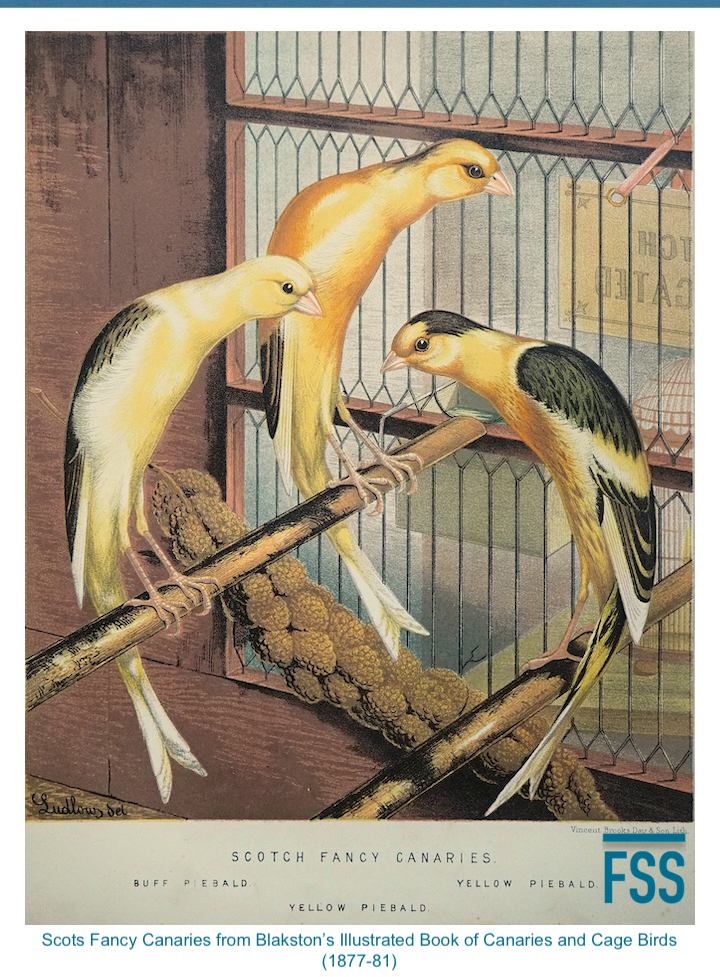
“This in every way most remarkable canary is, as its name suggests, a creation of our neighbours across the Tweed, and is wholly and entirely an exclusive speciality, as is the ‘postuur vogel’ in Belgium, of which birds it is doubtless an offshoot, and is, in truth, the‘postuur vogel’ of Scotland.”
W.A. Blakston in his introduction to ‘The Scotch Fancy Canary’ in ‘The Illustrated Book of Canaries and Cage Birds’, 1877-81.
So far, everything I’ve reported has confirmed that the bird we consider to be the classic Belgian canary possessed square shoulders, outstretched neck and a straight back forming a triangular profile.However as we go further back in time, another type of Belgian canary comes into view: a bird shaped like a semi-circle.Blakston’s Special Foreign Correspondent (SFC) remembered speaking to a man who had attended one of the first shows at Ostend ‘about thirty years ago’ (i.e. in the 1840s)
“I may remark in passing that this gentleman on seeing the illustrations of the Scotch Fancy in CANARIES AND CAGE BIRDS, observed respecting them, ‘Ah those were the birds of that day’.” (1)
A modern Scots Fancy canary. Credit: Donald Skinner-Reid.
Blakston was not alone in believing that the Scots Fancy was an ‘offshoot’ of the Belgian canary, but the SFC’s anecdote offers an alternative explanation: it may have descended from a different variety that existed in Belgium in the early nineteenth century. We have already seen that Jannin’s Canari Hollandaise, Brent’s ‘Bowed or Hooped Belgian’ and Varley’s ‘pure Belgian (old French) Canary’ all had gently curved backs, but they also had high shoulders and stiff upright legs, and thus were closely related to the triangular shaped postuurvogel. Scotland’s bird o’circle was quite different.
The earliest description of the Scots Fancy I have found was published by B.P. Brent in his series on the canary (1860) that I discussed in Part 2.His information came from a Mr. J. Ruthven of Glasgow who had written to him in 1859:
“Their shape is circled, and they should stand well up. The cages are furnished with two spars, eight or nine inches apart.The leap, the wheel or turn round, and the drawing themselves up with a quick lively motion and great nerve, are amongst their peculiarities.
They have no rise on the shoulder, and they should have a clean, smooth bosom, the tail well turned below the spar or perch.” (2)
He enclosed a drawing, but alas Brent did not reproduce it.Nevertheless, his written description leaves us in no doubt that this was indeed the classic Scots Fancy. The graceful arc of the Scots Fancy is a delight for the eye, but the Scottish fanciers were not satisfied.They wanted size too.Mr. Ruthven explained how they went about it:
“Our Scotch Fancy Canaries, I may say, average about five inches and a half [14 cm] in length, nervous, light made and active. We have some good birds six inches and a half [16.5cm], and our endeavour is to get them as long as we can, and as much circled . . .
Our Scotch fanciers prefer the Hooped Belgian, not because it is the proper shape, but because they think it will improve their Scotch breed by introducing them as a cross to get length and narrowness.
They give length and lightness, but it is difficult to get quit of the peak and the frill in the bosom, which is a bad fault in our birds.Then, again, they incline to give stiffness to the tail, which is another drawback.”
Brent reacted with concern: “I may remark, that on the whole the introduction of the Belgian cross seems likely to spoil the originality of the Scotch Fancy breed . . .” And so it proved.The inevitable consequence of introducing Hooped Belgian blood was that the birds began to develop high shoulders and longer legs, as can be seen in the illustration of the Scotch Fancy in Wallace’s ‘Canary Book’ some 15 years later:
Wallace’s illustration of the Scots Fancy from the first edition of ‘The Canary Book’ (1875)
Wallace acknowledged that the Scottish fanciers were divided about the changing style of the ‘Glasgow Don’ (an alternative name for the breed in its early years), designating them as the ‘new school’ and ‘old school’.He sided with the ‘new school’ and approved of the high shoulders (“an indispensable requisite”) and tolerated the exposed thighs (“not considered any detriment, so long as its general contour is correct”).Thus began the ruination of the bird o’ circle.
Unfortunately for the supporters of the original Scots Fancy there was little chance of bringing in fresh blood from Belgium because the Belgian breeders had long since adopted the straight backed postuurvogel as their ideal, and any strains of crescent-shaped canaries survived only in the memories of old fanciers. It seems that the birds which provided the foundation stock of the Scots Fancy were, by a remarkable twist of fate, among the last of their kind.
Wallace was the first author to attempt to discover the origins of the breed.He tells us his own enquiries had traced their history:
“for a period of forty years to a breed of birds which, although smaller in size and less elegant in form than the ‘Dons’ of the present day, were nevertheless possessors of the circular form and ‘souple’ [supple] tail, which are still the predominating features in this particular variety of canaries.” (3)
That takes us back to the mid 1830s.Blakston, who understood what a classic Scots Fancy should look like, had also made enquiries amongst the old breeders. He heard tales of “the first pair – the Girvan pair we think they were called, from the name of the town where they appeared” (4). It is a remarkable insight: the first pair of Scots Fancy canaries simply ‘appeared’ in Girvan, probably in the 1830s, and they were so unusual in form that they became known as ‘the Girvan pair’.It begs two questions: how do we explain their sudden appearance, and why did they appear in a small town like Girvan on the west coast of Scotland? The most obvious answer to the first question is that these birds must have been imported, but to answer the second we need to understand that Girvan was not a typical Scottish town in the early 19th century and, as we shall see, some of its inhabitants had an unexpected connection with Belgium.
Girvan harbour (undated). Credit: Tour Scotland.
Girvan is located about 50 miles south of Glasgow, and during the 1830s it was described as being:
“… occupied by the lowest order of immigrant Irish, who come hither in search of employment in cotton-weaving. The whole population, with inconsiderable exceptions, are cotton-weavers and their families. The number of hand-looms, including a few in the vicinity, was, in 1838, no fewer than 1,800. The fabrics woven are almost all coarse cottons for the manufacturers of Glasgow.” (5)
Life in Girvan: dyeing. Credit: ‘Weavers and Weaving in Girvan’ by James & Charlotte McCoid.Life in Girvan: spinning. Credit: ‘Weavers and Weaving in Girvan’ by James & Charlotte McCoid.
The preoccupation with weaving should come as no surprise; it was the most important industry in Scotland.Glasgow, which most people associate with shipbuilding, was founded on its weaving industry.It was Britain’s largest manufacturer of linen in the 1770s (6) and had 100 cotton mills by 1834 (7).By contrast, the first Clyde shipyard to build in iron only opened in 1837.
It is not only the high proportion of Irish weavers that makes Girvan stand out, but also the likelihood that some of them were of Belgian descent.Why would Belgians be found in an Irish weaving community on the west coast of Scotland?It may seem bizarre but it was the outcome of a string of events connected to the linen industry.
For centuries Belgium had been the centre of linen production in Europe, but the British government introduced measures to encourage the development of the linen industry in Ireland and Scotland throughout the 18th century (8).Britain’s growth as an international power was based on the strength of its navy; the ships were powered by sail, and sailcloth was made from linen. The policy had a strategic as well as a commercial purpose.
Ireland and Scotland had climates that were conducive to the growth of flax (9), but they also needed a skilled workforce to spin and weave the linen.In a fascinating investigation into the history of linen production at Cootehill in the north east of Ireland (10), Michael Brabazon explains how, at the beginning of the 18th century, the skills were provided by Huguenot weavers (11), but as demand for linen increased, the workforce was drawn from local Protestant weavers and later by the recruitment of Catholics too.
By the 1780s the British linen industry was in the ascendancy. Belgian manufacture suffered and wages declined (12). This had an impact across Belgium where “northeast Flanders produced the flax, and the rest of the interior produced the linen” (13). For the weavers of the ‘interior’ (i.e. Wallonia), Ireland offered not only an alternative source of employment, but also a Catholic weaving community that shared their faith.Thanks to Michael Brabazon’s research we know that many of them decided to emigrate because French names appear in the Catholic registers at Cootehill and Swinford.Furthermore he was able to trace some of those names to the area of modern Belgium that borders France; they were Walloons.
By 1830 sailing ships were being replaced by steamships, and falling demand resulted in the linen industry being overtaken by the manufacture of cotton fabrics..The west coast of Scotland offered new opportunities for Irish weavers after a steamer service between Belfast and Greenock started in 1818.It helps to explain why the proportion of people of Irish descent was much higher in Scotland than in England.Girvan was at the extreme end of the scale with some three-quarters of the 6,000 population being Irish-born in 1831. (14)
The Belfast steamer 1828 (credit: Irish genealogy toolkit)
In a brief search of the 1841 census I found some French names amongst the population of Girvan: Binnet, Bodon, Maney (Manet) and Rouand; a thorough search would surely reveal many more. They were almost certainly Catholics because none of these names appear in a directory of over 2600 Huguenot names published in 1892 (15).I have investigated various circumstances which might explain their presence in Girvan (16), but by far the most plausible is that they were drawn from the same cohort of Wallonian weavers that Michael Brabazon had discovered in northern Ireland.
A handloom weaver at work in 1906. Credit: Sorbie Family Website
Given this background, could they have been the source of the Girvan pair?
Before I answer that question it is important to note that the Wallonian weavers, unlike the Huguenot refugees a century before, were economic migrants.They emigrated to Ireland, and later Scotland, to look for work.As we know from modern experience, economic migrants often keep in close contact with their homeland.These two-way ties can continue for generations.
Do I think those weavers brought their canaries with them via northern Ireland to Scotland?It’s possible, but unlikely.Some of the original migrants would have regarded their migration as a temporary venture and later returned home; those who stayed would have been preoccupied with building a new life in a foreign country; canaries would have been an unnecessary distraction.
Do I think that once established in Scotland, they, or their descendants, might have visited their homeland (17) and brought back the canaries they knew from their youth?Yes.
Scottish judges and a Scottish canary from Blakston’s ‘Illustrated Book of Canaries and Cage Birds’ (1877-81)
Bear in mind that the canaries most Scots were familiar with in the 1830s would have been common songsters.Now imagine the sensation that a pair of canaries shaped like semi-circles would have created in Girvan, and how word would have spread when the weavers took their cotton fabrics to Glasgow (18).By the time that Blakston was making his enquiries in the 1870s, the breed was well established (19) and the ‘Girvan pair’ had passed into the folklore of the Scots Fancy canary.
Blakston was almost right; the Scots Fancy was certainly an ‘offshoot’ of a Belgian canary, but probably not the Belgian canary he had in mind.
__________________________
Acknowledgements and clarifications:
My thanks to Andy Early for the loan of his bound copies of Canary and Cage Bird Life, also to Thomas Müller and Uwe Feiter for permission to use their article first published in Der Vogelfreund in 2001, and to Donald Skinner-Reid for his photos and comments on the modern Scots Fancy.
During the 19th century, all writers, both English and Scots, used the term ‘Scotch’ for anything pertaining to Scotland.I have retained this term where it is used in the original texts, but otherwise I have deferred to the modern preference for ‘Scots’.
I have used two types of parentheses (brackets) in the text above. Curved brackets clarify something I, or the original author, have written; square brackets signify my clarification of what someone else has written.There are occasions when both are used in the same quotation.
Footnotes:
W. Blakston The Illustrated Book of Canaries and Cage Birds’ 1877-81, p.223.Clearly, Blakston must have sent the SFC a copy of the coloured plate in advance of publication.
B.P. Brent ‘The Cottage Gardner and Country Gentleman’, 30 October 1860.
R. L. Wallace ‘The Canary Book’, first edition 1875, p.131.Wallace was of Scottish descent, as his Christian names of Robert Linlithgow attest, so may well have known the old breeders to ask about the history of the breed.
W.E. Blakston, ‘The Illustrated Book of Canaries and Cage Birds’, 1878-80, p. 223.
“The Topographical, Statistical and Historical Gazetteer of Scotland,” 1848 courtesy of The National Trust for Scotland.
Brenda Collins & Philip Ollerenshaw, ’The Irish, Scottish and Flemish Linen Industries During the Long Eighteenth Century’, 2003.
Bird keepers will know flax as the plant that produces linseed.
Michael Brabazon ’The enigma of the ‘French’ linen-weavers of Cootehill and Swinford’, History Ireland, https://www.historyireland.com/enigma-french-linen-weavers-cootehill-swinford/ .
According to the Huguenot Society of Great Britain and Ireland, approximately 5,000 Huguenots settled in Ireland after fleeing prosecution in France.
Collins and Ollerenshaw op cit. “At the end of the century, unskilled or semi-skilled labourers in Flanders earned 60 to 70% of the wages of their English counterparts.Nonetheless, Vandenbroeke’s data show that both weavers and agricultural labourers experienced downward pressure on their incomes in the final quarter of the 18th century.” https://snr.org.uk/snr-forum/reply/2500/
Ibid. The authors cited Mendel’s assertion that “northeast Flanders produced the flax, and the rest of the interior produced the linen”.Thus the Walloons were more likely to be weavers than growers of flax.
“Irish Immigration to Scotland”, Irish Genealogy Toolkit.https://www.irish-genealogy-toolkit.com/Irish-immigration-to-Scotland.html. The 1841 census found that some 125,321 (4.8%) of the 2.6million population in Scotland was Ireland-born. In contrast, they made up only 1.8% in England and just 0.78% in Wales.It should be noted that the census predates the mass emigration from Ireland caused by the Great Famine of 1846 onwards.
Library Ireland, “The Huguenot Families Naturalised in Great Britain and Ireland (A-K)”, 5th edition, 1892.The list contains over 2,600 Huguenot surnames from A to K. Presumably the names from J to Z would double the total number.
One alternative explanation is that there was an influx of French Catholics fleeing the French Revolution during the final decade of the 18th century.However these refugees were mostly representatives of the Ancien Régime such as the nobility, the military and the church.Unlike the Huguenots of a century earlier, I have found no mention of weavers amongst them.


Very good article with which I agree.
I’m glad you liked it. I certainly enjoyed following the trail of evidence.
Fascinating story: the Girvan pair