This series would not have been possible without the contribution of Blakston’s ‘Special Foreign Correspondent’ (SFC). It was he, and only he, who recorded the activities of the Belgian canary societies, described the true posturvogel from personal observation, and provided clues about the origins of the Scots Fancy and Lancashire canary. The fact that Blakston only referred to him as his SFC tells us that he preferred to remain discreet at a time when most canary writers were only too happy to court fame. That only adds to the sense of mystery: who was he, and what do we know about him?
Blakston’s writings reveal that he was familiar with the Belgian way of doing things and seemed to speak the language; his written English was polished and he spoke with an ‘English voice’; finally, he was in regular correspondence with Blakston as he was completing his chapters on the Belgian canary (i.e. circa 1876/77).
Naturally Gust and I were keen to discover his identity. I suspected he was a British man who knew Belgium through family or business connections, but I couldn’t suggest any names. Gust came up with a list of potential Belgian or Dutch candidates, but there was always a hitch that ruled them out. I have to admit I was resigned to never discovering his identity, but Gust persisted and it was he who made the breakthrough. On searching the Felix archive in Antwerp he came across an advertisement for the De Arend show of 1899 to be held on 13 August for the young birds bred that year (1):


Now we had a name! With the benefit of hindsight I realised that James Dewar had been hiding in plain sight, as his name appears in Parts 1 and 6 of this series, but the dates were so far apart that I had not linked him to Blakston’s SFC.
Dewar is not an uncommon Scottish surname, but there were two connections with the cage bird fancy that seemed to be worth investigating. The first was John F. Dewar, the importer of Belgian canaries whom we met in Part 3. At first glance he seemed a good candidate, but I had to rule him out when his obituary noted that his first visit to Belgium was in 1882, many years after the SFC corresponded with Blakston. The second was the Dewar show cage, but that didn’t seem relevant because it was intended for the Border canary, and did not appear until some 50 years later. We didn’t seem any further forward, but Gust was enjoying the chase and was determined to find his man. He suspected that James F. Dewar and John F. Dewar were related, so he traced the Dewar family tree via one of the ancestry websites. This led him to contact Ian Glendinning of Aberdeen who was not only the great grandson of John Dewar, but also, as it transpired, the grandson of James Dewar. So John and James Dewar were father and son. Suddenly all the pieces of the jigsaw began to fall into place.
Ian explained:
“James Forrest Dewar 1857-1941 was my grandfather, but he died before I was born so I do not have any personal memories of him. My older sister does remember him as a much loved grandfather, but does not know anything of his relationship with his father.
My mother told us about grandfather James’s trips to Belgium in connection with his business (2), and that he acted as a judge at bird shows in Belgium. It seems he was well respected for this.
James’s father John Farquharson Dewar 1830-1907 also had a business in Edinburgh and his advertisements mention Belgium birds. I know John made a trip to USA to buy birds (3), but don’t have any record of him visiting Belgium. It seems likely that he did”
Father and son were both trading as ‘naturalists’ (taxidermists) and bird dealers from different premises in Edinburgh, as can be seen in the advertisements that Ian sent us:


This struck me as unusual. The convention of the day would have been for a proud father to encourage his son to join the family business and change its name to ‘John Dewar and Son’. Yet here they were in competition. It suggests a rift in the family, but Ian hadn’t been aware of it. He suggested that it might have something to do with John’s second marriage in 1879 following the death of his first wife, Jesse. Ian had reason to believe that John’s second wife was his eldest son’s step-daughter, and that while she was not a blood relation, James objected. How this unlikely couple got so close is not known, but it appears to have been a contented union. A tribute to John F. Dewar published in Canary and Cage Bird Life states:
“Mr. Dewar has been twice married, and has been fortunate in getting a good partner both times. Of the present Mrs. Dewar I cannot speak too highly. A more kindly or better manager one could not wish to have. As he puts it himself, he would not have been alive now if it had not been for her care and attention. He is ably assisted in his business by his youngest daughter. I am sure his many friends will wish Mrs. Dewar and himself many years of happiness to come.” (4)

It conveys a cosy picture of the Dewar family, but the fact that the author felt it was necessary to vouch for John’s second wife tells us that something was amiss. Nowadays it is not at unusual for the wife or partner of a well known bird keeper to feature in articles, but it was very unusual in the early 20th century. The author’s praise of her was so fulsome that there can be little doubt that it was intended to counter John’s critics.
There was also a significant omission from John’s obituary published in ‘Canary and Cage Bird Life’ in 1907: there was no mention of James. (5) The bird-keeping press must have been aware of the rift because it never spoke of father and son in the same article, even though both were renowned in the Scottish bird world. The magazine’s readers would surely have noticed this because James was Vice-President of the Scottish National CBS and his portrait had been included in its coverage of the show only two weeks earlier. (6)


The reverse was true as well. A ‘cameo’ of James published in the Scottish Poultry News in 1923 (7) states that “his father before him was a naturalist”, but never mentions John by name.

The ‘cameo’ is a glowing tribute to James and his achievements in the cage bird world. He is described as “the Father of the Scottish Cage Bird Fancy”, but I will confine my report to his involvement with the Belgian canary societies.
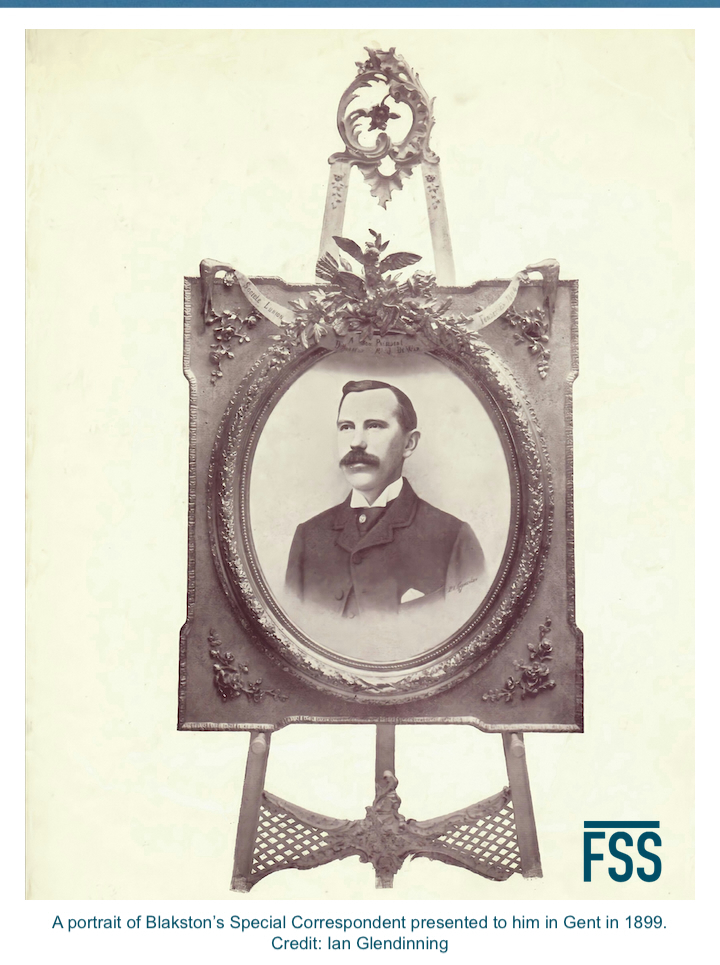
The anonymous author tells us that “Mr. Dewar was one of the first, if not the first, to go to Ghent and Antwerp to buy up the Belgian canaries and bring them back to this country”. He was a regular visitor to the Belgium, eager to “glean all the knowledge of the doings of the bird world there, and before very long he was able to speak the Flemish language like a native”. He officiated at shows on the continent and in 1895 was elected president of both the Ghent and Antwerp societies. In 1899 “he was presented at Ghent with a framed portrait of himself and easel, which he still treasures dearly”. This is the portrait you can see at the head of this article.
James Dewar’s connections with Belgium and its national breed of canary is just one chapter of his illustrious career. Back in Scotland, his involvement in the canary fancy extended far beyond his business activities. The Scottish Poultry News tells us he was “for many years Secretary of the Scottish Metropolitan Ornithological Association”, and acted as “Secretary of the first Scottish National in Edinburgh”. (8)
Now let’s turn to the Dewar cage. It is the official show cage of the Border Fancy and Fife Fancy (the latter with minor modifications), and the only show cage that is named after its creator. Surprisingly, there is nothing in official sources about Mr. Dewar himself, even though everyone knows his name. The only historic information I could glean about the Dewar cage was a short article by Frank Savage published in Cage and Aviary Birds in 1995 (9).

The Dewar cage is a celebration of the cage maker’s art: the cage bars are tied with fine copper wire before the joints are tin soldered; the vertical bars hook neatly over the arched top rail; the wooden side panels are grooved and, in the very best cages, have rounded tops; the seed trough takes the form of a sliding drawer with access to the seed via a slotted cover. The paintwork in the best cages has a high gloss finish, like Japanese lacquer.


The cage drinker is a marvel: the pop hole is an opening wrought from a single wire, whilst the cast glass drinker (alas plastic now) is retained in a hinged wire holder. The drinker can be removed and the holder folded flat against the side of the cage for storage. People take this arrangement for granted, but it is a clever and practical design. Finally, and perhaps best of all, there are little details whose principal purpose is to delight the eye: the four corner pillars comprise a slender urn-shaped baluster mounted on a square pedestal; the horizontal crossbars have curved ‘swags’; and the perches have spiral grooves. The entire assembly is a glorious tribute to the craftsmanship of a vanishing age.

It is significant that the article in the Scottish Poultry News makes no mention of the Dewar cage, which implies that his eponymous show cage was created after the publication of the article. Why did Dewar turn his attention to Border canaries?
We should remember that in the early 20th century, the Border canary was still regarded as an ‘up and coming’ variety. Claude St. John in his book ‘Our Canaries’ (1911), introduced it thus:
“Little more than 20 years ago it was a plebian nondescript, unhonoured, yet not unknown, with no more distinguished patronymic than the Common Canary; today it is, so to speak, the pride and joy of princes.”
The ‘Common Canary’ was being cultivated on either side of the Scottish border. C.A. House, who had been editor of Fur and Feather magazine, explained how it changed its name:
“Towards the end of the eighties [i.e. the 1880s] the men of Cumberland began calling the birds by the name of their county, and I was asked to assist in framing a standard, which I did. When the Southern Scots saw the Cumberland men forging ahead in this manner they declared war, and there was great controversy over the matter. The Scottish breeders said the Cumberland worthies had no right to claim the bird as their own, it was equally popular in the South of Scotland. . . . Eventually agreement was reached, and in the month of July 1890, peace was declared and an agreement reached that henceforth the breed should be known as – the Border Fancy.” (10)
There can be little doubt that James Dewar would have noticed the popular demand for Border canaries in his shop. As a cage maker, he would also have seen the opportunity to supply his customers with cages, but there was a problem: there were two styles of show cage being used by Border canary fanciers in the early 20th century. A motion to adopt a standard show cage had been rejected by members of the Border Fancy Canary Club in 1905 and again in 1907 (11). This meant that breeders on either side of the border continued to use their old show cages well into the 20th century.
The cage favoured by the Scots was illustrated by John Robson in his chapters on canaries in ‘Canaries, Hybrids and British Birds’ (1910-11). It is almost identical to a Dewar show cage, but lacked the glass drinker and its wire holder. Presumably a hook-on drinker was used instead.

The show cage used in Cumberland can be seen in a rather grainy photograph of the Border canaries at Cockermouth, probably in 1906 (12). Fortunately a detailed photograph was published in Chatterton’s ‘Canaries and How To Keep Them’ (1924-34). It shows a cage similar to the Scottish show cage, including a glass drinker and wire holder, but with a crude pop-hole and a straight mid-rail.


As the popularity of the Border canary spread across the country, breeders would have wanted a single approved show cage to avoid potential disqualification at shows. James Dewar’s solution was to combine the best features of the two: retaining the style of Scottish cage, but incorporating the glass drinker and wire holder of the Cumberland cage. He also, as Frank Savage reported, opted for narrow doors (presumably the 3 wire type – a useful theft deterrent) whereas most early cages were 4, 5 or even 6 bars wide. Thus the Dewar show cage was not a major innovation, but an amalgamation and refinement of two well-established patterns.
It was an important step in bringing unity to the Border fancy, yet I have been unable to find out how and when the Dewar pattern was adopted. Circumstantial evidence suggests that it was circa 1934, but it seems a strange omission when the history of the Border fancy was so well documented in other areas. Equally surprising is that James Dewar is not mentioned in any of the records I’ve seen, even though his cages were regarded by many fanciers as the ’gold standard’.
No doubt the British B.F.C.C. (the first nationwide club founded in 1928) would have argued that Mr. Dewar was just one of many makers capable of supplying the cage, and it didn’t want to favour a particular manufacturer. That’s understandable, but it didn’t stop the club naming Mr. James Sharp of Kilmarnock as setting the standard for the spiral ‘spars’ in 1936 (12).

The trade, of course, was happy to avoid naming the cage after a rival, even though their own branding left a lot to be desired. For example Thomas’s, a major supplier to the fancy, gave their version of the cage the snappy title of “Border Fancy Show Cage No 34 (Strictly Club Pattern)”.

Other cage makers were not so ‘strict’, and deviated from the Dewar pattern in the width of the door, the shape of the seed drawer slot, and the option of a circular pop-hole for the drinker. I’ve even read of brass knobs on the seed drawer.

It was not until the founding of the National Council of Border Fancy Canary Clubs in 1952 that details such as the use of oat husks for the floor covering, the position of the cage label, and the banning of circular pop-holes were adopted nationally. Despite the official support for the original cage pattern, there was still no mention of James Dewar.
Fortunately there must have been influential fanciers who felt that Mr. Dewar deserved credit for his show cage. I have found no record of a debate or campaign, but the outcome became clear when Terry Dodwell named it the Dewar cage in his book “Canaries” (1967). Thereafter the Border show cage became synonymous with the name of its creator.
It may have taken years for his good work to be recognised, but James F. Dewar has left us a wonderful legacy.

Acknowledgements:
- My thanks to Gust Truyens for his excellent detective work, and to Ian Glendinning for his family history.
- Thanks also to Andy Early for the loan of his bound volumes of ‘Canary and Cage Bird Life’.
Footnotes:
- In Britain we would call it a ‘nest feather’ show, although they are generally held earlier than August to avoid the moult.
- The advertisement for James’ shop implies that his business in Belgium was to import birds and supplies for his shop.
- John’s eldest daughter Jane had emigrated to the USA, and in 1873 John sailed on SS Australia to visit her. He was away for three months and, ever the businessman, took “a large Collection of British and Foreign Birds” on his outward journey and brought “a large collection of American Birds” on his return.
- D. Smith, Secretary of the Scottish National CBS, “One of Scotia’s Oldest Naturalists: Mr. John F. Dewar”, Canary and Cage Bird Life, 20 October 1905.
- Obituary of John F. Dewar, Canary & Cage Bird Life, 25 January 1907.
- Report on the fifth Scottish National show, Canary & Cage Bird Life, 7 January 1907.
- ‘Cage Bird Cameos: Mr James F. Dewar, Edinburgh’, The Scottish Poultry News, 28 September 1923.
- The first Scottish National show would presumably have been held in January 1902.
- For the sake of completeness, I later came across an article by Werner Coulter from Germany published in 2020. It is an amalgamation of Frank Savages’ article and the ‘cameo’ on James Dewar published in the Scottish Poultry News.
- C.A. House, “Canaries”, 1st edition 1923 (p. 230).
- ‘The Border Fancy Canary’, 6th edition, revised by James Houston, p.10.
- ‘Canary and Cage Bird Life’, 15 March, 1907.
This appears to be written in a language other than English.
Apologies Donald, I somehow managed to select ‘Symbols’ as the font. I’ve changed it back to Helvetica, so it should be legible now.
What a superb article. It deserves wider publicity in the fancy.
Huw regards it a “romantic” idea, about the origins of the domestic canary:
here it is:
The first wave of canaries were imported by the Portugese over the sea into Flanders (marriage Bourgondian Dukes and Portugese prinses) They were kept as posture birds on royale courts across Europe more peticular “het Hof ter Walle” later called “het prinsenhof or zoo” at Gent hence the large Gent bird.
Later a second wave of small green wild songcanaries followed the troops sent by the Spanish kings over land during the 80 year long war against the revolting Dutch. This route called in Dutch “De Spaanse Weg” crossed mountains (tiroler alps) and the Hartz.
Subscribers to this blog are asked for hard evidence about the idea!!
To get amateur historians a lead: the bookkeeping of Hof ter Walle is wel documentated and the original books are at ADN (Archives départementales du Nord te Rijsel (Lille France)). Probably the original handwriting is in Old French, so native French speakers have an advantage.
In a Dutch article: MARIA VAN BOURGONDIË IN HOF TEN WALLE
Over een jonge prinses en haar Gentse residentie (1465-1475)
Daniel Lievois (†) & Jelle Haemers””Deze bijdrage werd aangevat door Daniel Lievois en voltooid door Jelle Haemers. Veel dank gaat uit naar Christine Tierens voor de hulp bij de afwerking van dit artikel, en naar Marie Christine Laleman voor opmerkingen op een eerdere versie van deze tekst.””
I found this:
ADN: B 4111, 108r-v. In 1475 werd nog een (grotere) kooi (voor zangvogels) in haar kamer geïnstalleerd
Translated in English In 1475 an even bigger cage for songbirds was installed in her room.
So (ADN: B 4166, 88v) is a good start in the archive world.
I promise a lovely journey maybe even over the famous painting by Breughel the Elder: proverbs nr 37 about scissors ??
Regards Gust
I see you are in good form Gust!
On the English Wikipedia:
Spanish Road: https://en.wikipedia.org/wiki/Spanish_Road
Netherlandish Proverbs (Pieter Breughel the Elder:
https://en.wikipedia.org/wiki/Netherlandish_Proverbs
Just travelling along the Spanish Road. Between 1603 and 1609 the Spanish established Fort Fuentes. In 1706 the fort was abandoned and the Spanish horses of the fort spread along the neighbouring Swiss alpes establishing an old variety of horses: the Samolaco.
Following the romantic idea of the origin of the domestic canary, the first canaries were imported into Flanders by Isabel of Portugal at her court ( prinsenhof) in Bruges. Not to be confused with the court (prinsenhof – hof ter Walle) of her granddaughter Maria van Bourgondië at Ghent, hence the “Groote Gentse voghel” (Large Ghent Bird).
A scientific article in English about the Prince’s court at Bruges: a reconstruction of the lost residence of the Dukes of Burgundy with lots of references to original documents:
https://journal.eahn.org/article/id/7562/
Regards Gust Truyens
Do you have any evidence about the Bourgondië court and the Groote Ghentse vogel?
Unfortunately no, the court at Ghent famous for his lions, chained bears and apes along free roaming piecocks, cranes, pheasants and “chambre des joyaulx” with a white parrot and … maybe large Gent birds, is the birthplace of Keizer Karel V (Gent, 24 february 1500 – Spain, 21 septembre 1558).
This Emperor Charles V was married with Isabella of Portugal (1503 – 1539), not to be confused with his greatgrandmother Isabel of Portugal (1397 – 1472), the one according my idea introduced canaries at her court in Bruges.
Royal courts were a dynamic feature. During his childhood emperor Charles V was raised first in Ghent, later in Mechelen and Brussels. All these courts had a kind of little zoo’s and “rariteiten kabinetten” (jewellery rooms) along yards for playing even a predesesser of tennis courts (jeu de paume).
During his adult live Charles V travelled all of Europe and even beyond with a large following. It is said that the sun never set in his empire.
There is even an English connection, one of his godmothers is Margaretha of York: https://en.wikipedia.org/wiki/Margaret_of_York
A proverb I like:
Alone one travels fast, together one travels further.